The face changes over the years. Gradually, the skin may lose elasticity, tissues may shift from their original positions, and facial contours may no longer have the same definition.
In some people, these changes are most noticeable in the cheeks. In others, the jawline loses definition, nasolabial folds become more pronounced, and sagging begins to extend toward the neck.
This raises an important question: when does the face need only skincare, and when is greater tissue support necessary?
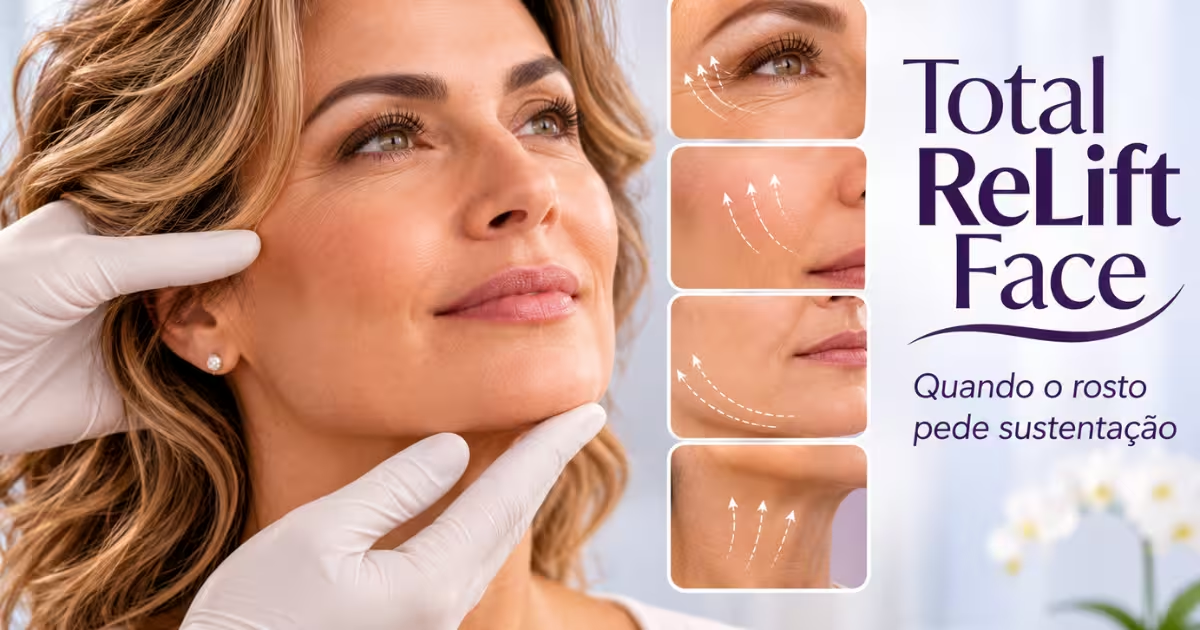
Total ReLift Face proposes a broader approach to facial rejuvenation. The goal is to consider the face as a whole, examining the anatomical changes that influence tissue support, contours, and overall harmony.
Rather than simply softening isolated signs of aging, facial planning should identify what has changed and which approaches may help restore a refreshed, natural-looking appearance.
What Is Total ReLift Face?
Total ReLift Face is associated with a comprehensive approach to facial rejuvenation, in which tissue support plays a central role.
As the face ages, different structures undergo changes. The skin loses some of its elasticity, fat compartments may experience changes in volume, and supporting tissues may shift from their original positions.
These changes do not occur in the same way in everyone.
For this reason, a facial rejuvenation approach should consider different areas of the face rather than focusing exclusively on wrinkles or the skin’s surface.
The assessment may include:
- Malar region: responsible for cheek projection.
- Nasolabial folds: the lines that extend from the sides of the nose toward the corners of the mouth.
- Jawline: which may lose definition as sagging develops.
- Lower face: where tissue accumulation may occur.
- Neck: which also contributes to the harmony of facial contours.
- Skin quality and deep tissue characteristics.
Based on this analysis, the plastic surgeon can identify the predominant changes and discuss possible treatment options.
It is important to emphasize that this approach does not mean that several procedures must be performed. Recommendations depend on each patient’s anatomy, medical condition, and individual needs.

Why Does the Face Lose Support Over Time?
Facial aging is a multifactorial process. It involves changes in the skin, fat, muscles, ligaments, and bone structures.
The combination of these changes directly influences the appearance of the face.
1. Reduced Skin Elasticity
Collagen and elastin are important components responsible for skin firmness and elasticity.
As we age, the production and organization of these fibers change. Consequently, the skin may become less capable of retracting.
Cumulative sun exposure, smoking, and genetic factors also influence this process.
2. Changes in Fat Compartments
Facial fat contributes to volume and the distribution of facial contours.
Over the years, some fat compartments may lose volume, while others may change position or projection.
This process helps explain why some people notice a more hollow appearance in the cheek area and greater tissue accumulation in the lower face.
3. Changes in Supporting Structures
Ligaments and other supporting elements help maintain the organization of facial tissues.
Over time, changes in these structures contribute to shifts in the position of soft tissues.
As a result, the jawline may lose definition and sagging may become more noticeable.
4. Bone Changes
Aging also involves changes in the facial bone structure.
Remodeling in certain areas may alter the support points for soft tissues, influencing cheek projection, the eye area, and facial contours.
These factors demonstrate why facial rejuvenation should not focus on the skin alone.
What Signs May Indicate That the Face Needs More Support?
Facial aging does not always begin with deep wrinkles.
In many cases, the first changes are related to a loss of contour definition and shifts in tissue position.
Some signs deserve attention:
Loss of jawline definition: The line separating the face from the neck may become less defined.
Sagging in the cheeks: Tissues in the malar region may shift, changing the shape of the face.
More pronounced nasolabial folds: Lines near the nose and mouth may become more noticeable.
Volume accumulation in the lower face: Tissue accumulation may alter the appearance of the jawline.
Neck laxity: The skin and tissues in the cervical region may become less firm.
A tired appearance: The combination of volume loss and changes in tissue support may create an appearance that differs from how a person perceives themselves.
These signs do not, on their own, indicate a need for surgery. A medical assessment is necessary to identify their causes and possible treatment options.
Total ReLift Face and Facelift: What Is the Relationship?
A facelift, also known as rhytidectomy, is a plastic surgery procedure designed to address certain signs of facial aging.
Its planning considers tissue repositioning, correction of sagging, and the restoration of more harmonious contours.
The relationship between the concept of facial support and a facelift lies in the need to address changes that go beyond the skin’s surface.
In patients with significant sagging, the surgeon may assess whether a surgical approach is appropriate.
One option is the Deep Plane Facelift, a technique that works with deeper layers of facial tissue and allows them to be repositioned.
The choice of technique depends on factors such as:
- Facial anatomy.
- Degree of skin and tissue laxity.
- Skin quality and thickness.
- Distribution of facial volume.
- Characteristics of the jawline.
- The patient’s medical condition and expectations.
Not everyone needs the same technique. Treatment planning should respect individual characteristics and the limitations of each procedure.
What Is the Difference Between Treating the Skin and Repositioning Tissues?
This distinction is essential to understanding the possibilities of facial rejuvenation.
Treatments focused on skin quality may help improve aspects such as texture, hydration, pigmentation, and certain manifestations of mild skin laxity.
Surgical rejuvenation procedures, on the other hand, address deeper anatomical changes, especially when tissue displacement and excess skin are present.
These approaches therefore have different goals.
Someone with predominantly superficial skin changes may have different needs from someone with significant sagging in the lower face.
A specialist assessment helps determine which structures require attention and whether clinical treatment, an aesthetic procedure, or surgery may be appropriate.
How Can Natural-Looking Results Be Preserved in Facial Rejuvenation?
One of the main challenges of facial plastic surgery is achieving a rejuvenated appearance without changing the patient’s identity.
The goal should not be to completely transform facial features or create an artificially tightened appearance.
To achieve this, treatment planning must consider the patient’s original anatomy, facial proportions, and individual characteristics.
Some aspects are particularly important:
Respect for facial identity: Preserving the features that are part of each person’s expression and individuality.
Assessment of different facial areas: Observing the relationship between the cheeks, jawline, lower face, and neck.
Appropriate technique selection: Considering the degree of sagging and the patient’s anatomical needs.
Realistic expectations: Explaining what can be addressed and the limitations of the procedure.
Medical follow-up: Providing guidance throughout the preparation and recovery stages.
In plastic surgery, natural-looking results do not mean the absence of change. They mean seeking harmony without compromising facial identity.
Who May Benefit from an Assessment for Total ReLift Face?
People who notice progressive changes in facial support may benefit from an assessment with a plastic surgeon.
This includes patients with sagging in the lower face, loss of jawline definition, changes in the cheeks, or alterations in the neck contour.
Age alone does not determine whether a procedure is appropriate.
Two people in the same age group may have completely different anatomical characteristics. Similarly, the degree of sagging does not depend exclusively on chronological aging.
Medical history, skin quality, previous procedures, and personal expectations must also be considered.
A consultation helps determine whether a facelift, Deep Plane Facelift, or another facial rejuvenation approach may be appropriate.
Total ReLift Face in São Paulo: Individualized Assessment with Dr. José Salim Cury
Facial support requires a careful analysis of the structures involved in the aging process.
In São Paulo, Dr. José Salim Cury (CRM-SP 150220 · RQE 82241) works in plastic surgery, with a particular focus on facial rejuvenation and the planning of procedures that respect each patient’s anatomy.
His approach recognizes the importance of understanding individual needs before defining any intervention.
During the assessment, the following aspects may be examined:
- Distribution of facial volume.
- Degree and location of skin and tissue laxity.
- Definition of the jawline.
- Condition of the skin and deeper tissues.
- Harmony between the face and neck.
- Medical history and previous procedures.
The clinic is located in Vila Olímpia, São Paulo, and offers individualized consultations for patients interested in facial rejuvenation.
Treatment planning should clarify available options, associated risks, recovery, and realistically expected results.
Schedule an assessment with the team of Dr. José Salim Cury (CRM-SP 150220 · RQE 82241) to discuss facial rejuvenation options suited to your individual characteristics.
Follow our Instagram profile.
Frequently Asked Questions About Total ReLift Face
What Does Total ReLift Face Mean?
Total ReLift Face is associated with a comprehensive approach to assessing facial support, considering skin and tissue laxity, tissue positioning, volume, and contours. The recommendation of specific techniques depends on a medical assessment.
Is Total ReLift Face a Surgical Procedure?
The expression may be used to describe an approach to facial rejuvenation. It is important to confirm with the medical team which procedures and techniques are included in the protocol being offered.
What Is the Difference Between Total ReLift Face and a Facelift?
A facelift is a plastic surgery procedure designed to address signs of facial aging, including sagging and changes in tissue positioning. Total ReLift Face is the name of an approach whose scope should be defined by the responsible medical team.
Does a Deep Plane Facelift Improve Facial Support?
A Deep Plane Facelift works with deeper layers of facial tissue and allows them to be repositioned. Its suitability depends on each patient’s anatomy and degree of sagging.
At What Age Can Someone Have a Facelift?
There is no single age at which a facelift is recommended. The decision takes into account the patient’s medical condition, anatomical characteristics, degree of sagging, and individual goals.
Where Can I Get an Assessment for Facial Rejuvenation in São Paulo?
Dr. José Salim Cury offers assessment consultations for facial plastic surgery at his clinic in Vila Olímpia, São Paulo. The recommendation of any procedure depends on an individualized medical assessment.
Medical Disclaimer: This content is intended for informational purposes only. Surgical procedures involve risks and require an individualized medical assessment. Results vary according to each patient’s characteristics.