
Deciding to undergo plastic surgery often brings a mixture of emotions. There is excitement about the expected result, the desire for change, and, at the same time, questions about anesthesia, recovery, and potential risks.
These concerns are legitimate.
Before thinking about technique, scars, or the final result, there is one question that should guide the entire decision: Is this surgery being planned safely?
Safe plastic surgery does not depend on a single factor. It is built through a combination of appropriate indication, professional qualifications, clinical evaluation, hospital facilities, anesthesia, planning, and postoperative follow-up.
It is also important to understand that no surgical procedure is completely free of risks. The role of a responsible medical approach is to identify these risks, evaluate each patient individually, and adopt measures to reduce them.
Therefore, anyone looking for a plastic surgeon in São Paulo should evaluate much more than before-and-after photographs.
Safety begins with the first consultation.
Choosing a Plastic Surgeon Is One of the First Criteria
Trust in a medical professional is important, but it should be accompanied by objective criteria.
Before undergoing surgery, patients should understand the physician’s training and verify their professional qualifications.
Some points deserve attention:
- Valid professional registration.
- Specialist qualification in Plastic Surgery.
- Experience with the desired procedure.
- Practice in appropriate hospital facilities.
- Clear communication during the consultation.
- Commitment to care before and after surgery.
In addition to researching the surgeon’s professional background, patients can check medical records through the official channels of Medical Councils.
The choice should not be based solely on the surgeon’s popularity or social media content.

Safe Surgery Begins With the Right Indication
The procedure a patient believes is ideal is not always the most appropriate one for their anatomy.
This difference is fundamental.
A person may arrive at a consultation wanting a specific procedure and discover that another technique offers a more appropriate approach. In other cases, the surgeon may determine that it is not the right time to operate.
A responsible evaluation considers:
- Individual anatomy.
- Degree of skin laxity.
- Tissue quality.
- Clinical conditions.
- Patient goals.
- Surgical limitations.
- The relationship between risks and benefits.
A surgeon must also know when to say “no” when surgery is not indicated.
This does not represent a limitation in care. It represents a commitment to safety.
The First Consultation Should Go Beyond Aesthetics
The consultation should not be used only to decide how a particular area will look after surgery.
It is a medical evaluation.
The surgeon needs to understand the patient before defining the surgical plan.
Therefore, during the consultation, it is important to discuss:
- Current and previous medical conditions.
- Previous surgeries.
- Regular medications.
- Allergies.
- Smoking.
- Alcohol consumption.
- Vitamins and supplements.
- History of surgical or anesthetic complications.
- Goals and expectations.
Patients should provide this information transparently.
Even medications or supplements considered routine may be relevant to surgical planning.
Preoperative Tests Need to Be Individualized
It is common to associate surgical preparation with a list of tests. However, safety does not simply mean requesting the largest possible number of tests.
Tests should be defined according to the patient and the procedure.
Depending on the case, the surgeon may request:
- Laboratory tests.
- Cardiac evaluation.
- Electrocardiogram.
- Imaging tests.
- Additional evaluations by other medical specialties.
Age, medical history, medications, and the complexity of the surgery help determine what needs to be investigated.
If an abnormality is identified, additional investigation may be necessary or the procedure may even need to be postponed.
Operating on the originally planned date should never be more important than operating under appropriate conditions.
The Hospital Where Surgery Is Performed Matters
The choice of where surgery will take place is another point that deserves attention.
Elective surgery is still a medical procedure. Therefore, the facility needs to be compatible with the complexity of the operation and provide appropriate conditions for patient care.
Before surgery, it is important to understand:
- Where the procedure will be performed.
- What facilities will be available.
- How the operating room functions.
- Who will be part of the medical team.
- How monitoring will be conducted.
- What support will be available in case of an unexpected event.
For Dr. José Salim Cury (CRM-SP 150220), hospital facilities are part of surgical planning.
A high-standard experience should not be understood only in terms of comfort. In medicine, facilities, medical teams, and the ability to provide appropriate care are much more important.
The Anesthesiologist Plays a Fundamental Role in Safety
Many patients focus exclusively on the plastic surgeon, but anesthesia also requires specialized planning.
Before and during surgery, the anesthesiologist participates in patient care and monitors different parameters.
These may include:
- Blood pressure.
- Heart rate.
- Oxygenation.
- Ventilation.
- Temperature.
- The body’s response to anesthesia.
The type of anesthesia depends on the procedure and the patient’s clinical characteristics.
For this reason, previous experiences with anesthesia, allergies, medical conditions, and medications must be accurately reported.
Surgical Time Also Needs to Be Considered
Performing several procedures during the same surgery may seem convenient. After all, it can allow part of the recovery period to be concentrated into a single period.
However, combining procedures requires careful evaluation.
Planning should consider:
- The complexity of each procedure.
- Clinical conditions.
- Estimated operating time.
- The extent of the areas being treated.
- Type of anesthesia.
- Expected recovery.
- Available hospital facilities.
Combined procedures may be appropriate for selected patients.
However, when the combination does not offer an adequate balance between risks and benefits, performing the surgeries in stages may be a more prudent decision.
More procedures in a single operation do not necessarily mean better planning.
Facelift Also Requires a Comprehensive Patient Evaluation
In facial rejuvenation, planning goes far beyond deciding how much skin should be treated.
Modern facelift surgery involves understanding facial aging and the structures responsible for the changes perceived by the patient.
During the evaluation, the surgeon may analyze:
- Cheeks.
- Jawline.
- Jowls.
- Neck.
- Skin quality.
- Tissue distribution.
- Deep facial structures.
Based on this analysis, the surgeon determines whether there is a surgical indication and which approach may be most appropriate.
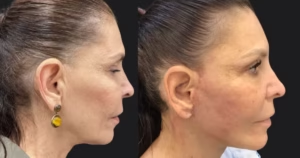
In the work of Dr. José Salim Cury (CRM-SP 150220), natural-looking results and preservation of the patient’s identity are central elements of this planning.
The goal is not simply to make the face look tighter. It is to achieve facial rejuvenation while respecting individual anatomy.
Procedures Combined With a Facelift Need Appropriate Indication
In certain patterns of facial aging, different areas may need to be addressed as part of the same treatment plan.
In Dr. José Salim Cury’s practice (CRM-SP 150220), blepharoplasty is considered when there is an indication to combine it with a facelift as part of a comprehensive facial rejuvenation strategy.
This evaluation may consider:
- Excess eyelid skin.
- Fat pockets.
- Facial laxity.
- Cheek descent.
- Loss of jawline definition.
- Neck changes.
The goal is to avoid treating one area in isolation when the aging process involves different structures.
Once again, technique comes after diagnosis.
For Body Procedures, Weight Stability Also Matters
Patients considering abdominoplasty, liposuction, Lipo LAD, or other body contouring procedures need to understand that plastic surgery does not replace weight loss.
Body weight stability can be important both for surgical planning and for maintaining results.
Before surgery, the following may be evaluated:
- Current weight.
- History of weight fluctuations.
- Fat distribution.
- Excess skin.
- Tissue quality.
- Nutritional status.
- General health.
When significant additional weight loss is still planned, it may be necessary to discuss whether it is actually the best time to undergo surgery.
Mommy Makeover Requires Special Attention to Planning
After pregnancy and motherhood, some women experience simultaneous changes in the abdomen, waist, and breasts.
A Mommy Makeover allows for an individualized plan to address these changes.
Depending on the case, the following may be considered:
- Abdominoplasty.
- Liposuction.
- Mastopexy.
- Breast surgery.
- Other individually indicated procedures.
However, a Mommy Makeover should not be interpreted as a mandatory “package” of surgeries.
Not every procedure needs to be performed, and they do not always need to take place during the same operation.
The goal is to define the most appropriate strategy for that woman, at that particular stage of her life, and under safe conditions.
Smoking, Medications, and Supplements Must Not Be Omitted
Certain habits and substances can interfere with surgery or recovery.
Smoking, for example, deserves particular attention because of its effects on circulation and wound healing.
The medical team also needs to know everything the patient regularly uses.
Be sure to report:
- Cigarettes and other nicotine products.
- Prescription medications.
- Over-the-counter medications.
- Anticoagulants or antiplatelet medications, if used.
- Vitamins.
- Herbal products.
- Supplements.
- Medications used for weight loss.
No medication should be discontinued without medical guidance.
Whenever an adjustment is necessary, it should be recommended by the responsible medical team.
Realistic Expectations Also Make the Decision Safer
Safety is not limited to physical aspects.
Patients need to understand what surgery can and cannot achieve.
Before the procedure, it is important to discuss:
- Possible results.
- Limitations of the technique.
- Scars.
- Recovery time.
- The possibility of asymmetries.
- How results evolve over time.
- Risks and possible complications.
Be cautious of promises of perfection or absolute guarantees of results.
The human body has individual characteristics, and healing also varies from person to person.
An informed decision is built on expectations that are compatible with reality.
Postoperative Care Needs to Be Organized Before Surgery
Safety does not end when the procedure is over.
The recovery period is part of the treatment and needs to be planned in advance.
Before surgery, organize aspects such as:
- Transportation after discharge.
- Someone responsible for providing initial support.
- Time away from work.
- Assistance with children or family members.
- Household tasks.
- An appropriate environment for rest.
- Medical follow-up appointments.
This preparation is particularly important for procedures that require greater physical restrictions during the first few days.
Patients need to have realistic conditions to respect the recovery period.
Following Postoperative Instructions Is Essential
Each procedure has specific postoperative recommendations.
Patients should follow the instructions provided by their medical team precisely, rather than adapting their recovery based on friends’ experiences or information found online.
Depending on the surgery, recommendations may include:
- Incision care.
- Use of compression garments or surgical garments when indicated.
- Sleeping position.
- Restrictions on certain movements.
- Guided walking.
- Correct use of prescribed medications.
- Gradual return to activities.
Starting exercise too early or ignoring restrictions may interfere with recovery.
The body needs time to heal.
Recognizing Changes During Recovery Is Also Important
Before discharge, patients should know how to contact their medical team and which situations need to be reported.
Symptoms that may require medical evaluation include:
- Shortness of breath.
- Severe or worsening pain.
- Fever.
- Significant bleeding.
- Unexpected or marked asymmetrical swelling.
- Significant changes in the incisions.
- Other symptoms that differ from what the medical team explained.
This does not mean that every discomfort represents a complication.
The important point is not to try to diagnose a significant change on your own.
When in doubt, contact the medical team.
Price Should Not Be the Main Criterion When Choosing Surgery
Cost naturally plays a role in planning for any private medical procedure.
However, making price the main criterion may cause much more important factors to be overlooked.
When comparing options, consider:
- Professional qualifications.
- The surgeon’s experience.
- Hospital facilities.
- Medical team.
- Anesthesia.
- Preoperative planning.
- Postoperative follow-up.
Plastic surgery involves health.
Therefore, the decision should not be driven by the search for the cheapest option, but by an understanding of the entire care process involved.
What Questions Should You Ask Your Surgeon Before Surgery?
Arriving at the consultation prepared can help you make a more informed decision.
Do not be afraid to ask questions.
Some important questions include:
- What procedure is actually indicated for me?
- Why was this technique chosen?
- What are the main risks?
- Where will my surgery be performed?
- Who will be responsible for my anesthesia?
- Do I need any additional evaluations?
- What will my recovery be like?
- How long will I need to stay away from work?
- How will follow-up care work after surgery?
A high-quality medical consultation should provide enough space to clarify questions.
Trust increases when patients understand each stage of their journey.
Safety, Natural-Looking Results, and Planning in Dr. José Salim Cury’s Approach
For Dr. José Salim Cury (CRM-SP 150220), in São Paulo, plastic surgery begins with an individualized evaluation.
Especially in facelift surgery and facial rejuvenation, planning seeks to understand each patient’s aging process before selecting the technique.
The approach considers factors such as:
- Individual anatomy.
- Degree of aging.
- Clinical conditions.
- Hospital facilities.
- Surgical safety.
- Natural-looking results.
- Preservation of identity.
The same principle guides the planning of body and breast procedures.
The question should not simply be “Which surgery can be performed?”, but rather “Which surgery makes sense for this patient, and under what conditions should it be performed?”
This difference transforms plastic surgery from a purely aesthetic decision into a conscious medical decision.
Follow our Instagram profile.
Safety Is Built Throughout the Entire Surgical Journey
When we talk about safety in plastic surgery, there is no single factor capable of guaranteeing a risk-free experience.
Safety is built.
It begins with choosing a qualified surgeon, continues through appropriate indication, clinical evaluation, tests, anesthesia, and hospital facilities, and extends throughout postoperative follow-up.
It also requires active patient participation, transparency about their health, and a willingness to follow medical recommendations.
The aesthetic result matters. Natural-looking results matter. The experience matters too.
But all these goals must remain subject to the same principle:
Before thinking about how you will look after surgery, it is essential to carefully plan how you will go through it.
Schedule a Consultation With Dr. José Salim Cury in São Paulo
If you are considering a facelift, facial rejuvenation surgery, Mommy Makeover, abdominoplasty, liposuction, or breast surgery in São Paulo, the first step should be an individualized medical evaluation.
Schedule a consultation with Dr. José Salim Cury (CRM-SP 150220) to discuss your goals and understand which options are actually appropriate for your case.
During the consultation, your medical history, anatomy, expectations, and all the factors necessary to develop a responsible treatment plan will be evaluated.
Do not choose only a surgery. Choose a process based on medical evaluation, safety, natural-looking results, and care at every stage.