
One of the most common concerns among people considering plastic surgery involves scars. Where will they be located? How long will they be? Can they be made less noticeable? What is the healing process like?
These questions are important because every surgery involving skin incisions leaves some degree of scarring. However, the final appearance depends on several factors, including the technique used, the area treated, and each person’s individual healing characteristics.
Surgical planning considers not only the desired transformation but also the location of the incisions and the quality of the healing process.
In this article, learn how scars are planned, which factors influence their development, and what to expect during postoperative recovery.
Why Does Every Plastic Surgery Procedure Leave Scars?
A scar is the natural result of the skin’s healing process after a surgical incision.
When a surgeon makes an incision, the body initiates a series of responses to close the area and rebuild the tissues.
During this process, collagen is produced and reorganized. This protein is essential for the structure and strength of the skin.
Scar healing occurs in different phases:
- Inflammatory phase: begins immediately after surgery, as the body responds naturally to the injury.
- Proliferative phase: new tissue forms, and the incision gradually closes.
- Remodeling phase: collagen reorganizes, and the scar undergoes changes in texture, thickness, and color.
These stages take place over several months. Therefore, the appearance of a scar during the first few days does not necessarily represent its final result.
How Does the Surgeon Plan Scar Placement?
Incision planning is part of the surgical strategy.
Before the procedure, the surgeon evaluates the patient’s anatomy, the amount of skin that needs to be removed, the area being treated, and the position of the structures that will be repositioned.
The goal is to make the incisions necessary to perform the technique safely while also considering the possibility of placing scars in less exposed areas.
The factors assessed include:
- Anatomy: each area has its own skin and tissue characteristics.
- Excess skin: the amount of tissue that needs to be removed influences the length of the incisions.
- Natural body lines: whenever possible, incisions are planned around natural folds and anatomical contours.
- Movement in the area: regions subject to movement and tension require special attention.
- Skin quality: elasticity and thickness can influence healing.
- Surgical technique: different procedures require specific incision patterns.
A less noticeable scar should never come at the expense of an inappropriate surgical approach. The priority is to perform the recommended procedure while respecting the patient’s anatomy and safety.
What Are the Different Types of Plastic Surgery Scars?
The location and length of scars vary depending on the procedure.
Understanding the most common patterns helps explain why some surgeries leave smaller marks, while others require longer incisions.
Periareolar Scar
This incision is made around the areola and is generally used in selected breast procedures.
It may be used in certain breast lift procedures and breast augmentation or reduction surgeries.
Its suitability depends on the degree of breast sagging, excess skin, and anatomical characteristics. It is not appropriate for every case.
Vertical Scar
This incision begins around the areola and extends downward toward the inframammary fold.
It is used in some breast lift and breast reduction techniques, allowing the surgeon to remove skin and reshape the breasts.
Inverted T Scar
This pattern combines an incision around the areola, a vertical line, and a horizontal incision along the inframammary fold.
It may be necessary when there is greater excess skin and significant breast sagging.
Horizontal Scar
This type of scar is used in procedures such as abdominoplasty.
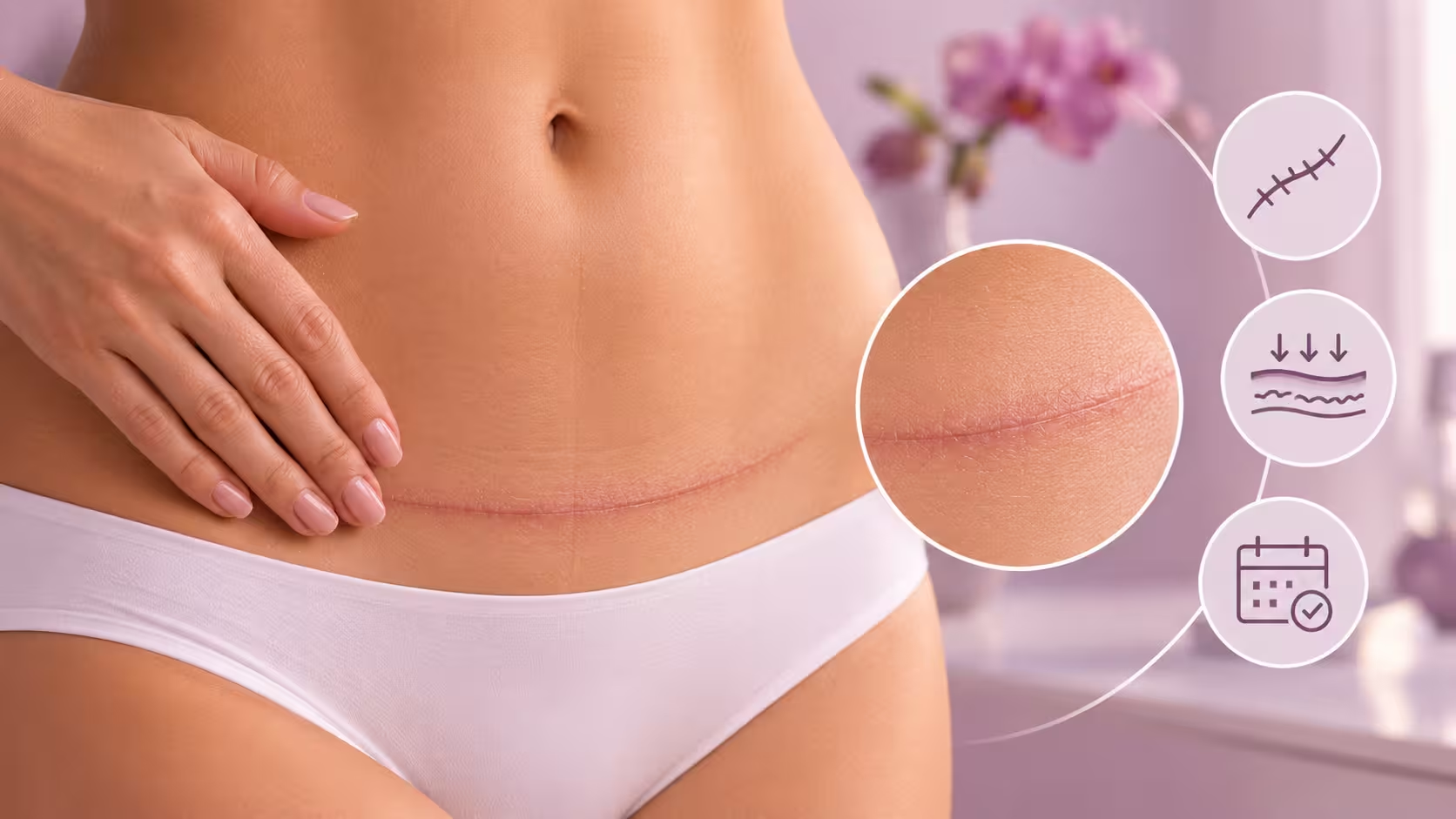
Its location is usually planned in the lower abdomen, taking body proportions and the possibility of concealing it beneath underwear or swimwear into consideration.
Its length varies according to the amount of skin that needs to be removed.
Scars Around the Ears
In facial rejuvenation procedures, such as a facelift, incisions may be planned close to the natural structures of the ears and the hairline.
Their placement depends on the technique, the patient’s anatomy, and the need to reposition tissues.
The goal is to integrate the scars into the natural contours of the face without compromising safety or the execution of the procedure.
Do Scars Disappear Completely?
No. A surgical scar is permanent, although its appearance can improve significantly over time.
During the first few months, it is common for scars to appear pink or reddish and present sensitivity and changes in texture.
Gradually, the area tends to undergo a maturation process. The scar may become lighter, flatter, and less noticeable.
However, healing varies from patient to patient.
Some people develop thin, discreet scars. Others develop thicker or more pigmented marks, even when they follow appropriate care instructions.
For this reason, it is important to understand that surgical planning aims to support good healing but cannot guarantee a specific appearance.
What Influences Scar Quality?
The final appearance of a scar depends on factors related to both the procedure and the body’s individual response.
Genetics and Skin Characteristics
Some people have a greater predisposition to developing hypertrophic scars or keloids.
These conditions involve excessive scar tissue production and may cause raised, thickened, and uncomfortable scars.
Personal and family medical history helps the surgeon identify potential risk factors.
Tension in the Surgical Area
Tension on the incision can interfere with the healing process.
Areas subject to frequent movement or stretching require specific care during recovery.
For this reason, the surgeon provides guidance on movement restrictions and physical activities according to the procedure performed.
Smoking
Smoking impairs circulation and reduces the availability of oxygen in the tissues.
This effect can compromise healing and increase the risk of complications.
It is essential to inform your doctor about the use of cigarettes, electronic smoking devices, and other nicotine products.
The medical team should provide guidance on the appropriate period to stop using these products before and after surgery.
Nutrition and Nutritional Status
Tissue recovery depends on adequate nutritional conditions.
Proteins, vitamins, and minerals participate in different processes involved in the body’s repair mechanisms.
After significant weight loss or bariatric surgery, it is especially important to investigate possible nutritional deficiencies.
Sun Exposure
Ultraviolet radiation can contribute to pigmentation changes in recent scars.
For this reason, sun protection is an important part of postoperative care, following medical guidance.
How Should You Care for Scars After Surgery?
Postoperative care influences scar development and should follow the surgeon’s instructions.
There is no single protocol that applies to every procedure. The type of incision, the area treated, and the stage of healing determine the necessary care.
Recommendations that may be part of postoperative follow-up include:
- Keep dressings in place according to medical instructions.
- Clean the area as directed.
- Avoid friction and excessive tension on the incision.
- Do not remove scabs or manipulate stitches on your own.
- Respect the recommended period away from physical activities.
- Use sun protection when medically approved.
- Attend follow-up appointments.
In some cases, the doctor may recommend specific products, such as silicone sheets or gels, to help manage certain types of scars.
These products should not be used indiscriminately. Their recommendation depends on an assessment of the area and the stage of healing.
When Does a Scar Need Medical Evaluation?
Some changes are part of normal recovery. However, certain signs need to be assessed by the medical team.
These include:
- Intense or progressively worsening redness.
- Pain that increases instead of improving.
- Significant local warmth.
- Discharge or an unpleasant odor.
- Opening of the incision.
- Fever associated with changes in the operated area.
- Excessive thickening or growth of the scar.
These signs may indicate complications, such as infection or abnormal healing.
Do not wait for your next scheduled appointment if warning signs appear. Contact the responsible medical team for guidance.
Is It Possible to Improve the Appearance of a Scar?
Yes. Depending on the characteristics of the scar, treatments are available that may improve its appearance and texture.
The choice depends on the type of change present.
Possible options include:
- Topical silicone: may be recommended to help manage hypertrophic scars.
- Laser treatment: certain types of lasers may help address changes in color, texture, and thickness.
- Injections: may be considered for raised scars, such as keloids and some hypertrophic scars.
- Surgical revision: in selected cases, surgery may be performed to correct scars with significant changes.
It is important to remember that no treatment completely eliminates a scar. The recommendation must take into account the benefits, limitations, and appropriate timing for intervention.
Does Scar Planning Change Depending on the Surgery?
Yes. Each procedure requires its own strategy.
In body contouring surgeries after significant weight loss, for example, larger amounts of skin may need to be removed. This can result in longer scars.
In facial procedures, planning takes into account the natural contours of the face, the hairline, and the structures around the ears.
In breast surgeries, the scar pattern depends on the degree of sagging, the existing breast volume, and the amount of skin that needs to be removed.
For this reason, scars should be discussed before surgery. Patients need to understand the likely location of the incisions and the consequences of the proposed technique.
Scars and Expectations: What Should You Discuss With Your Plastic Surgeon?
During the consultation, it is important to speak openly about your concerns.
If the appearance of scars is particularly important to you, let your surgeon know before making a decision.
Some questions may help:
- Where will the scars be located?
- How long are they expected to be?
- Is there another technique with a different incision pattern?
- Does my skin have any characteristics that may affect healing?
- Do I have a history of keloids or hypertrophic scars?
- What care will I need after surgery?
- When will I be able to assess the more mature appearance of the scar?
Open communication helps align expectations and clarify the technical decisions involved.

Scars Are Part of Surgical Planning, Not Something That Should Come as a Surprise
Plastic surgery aims to address anatomical concerns and achieve results that are compatible with each patient’s individual characteristics. However, every incision leaves a permanent mark.
Careful planning considers scar placement, the technique used, tissue quality, and the care required during recovery.
Rather than promising invisible scars, the surgeon should explain what patients can realistically expect and how each stage of the process will be managed.
Individualized Assessment With Dr. José Salim Cury in São Paulo
If you are considering plastic surgery, discussing scars is an important part of your consultation.
Dr. José Salim Cury, a plastic surgeon in São Paulo, provides individualized assessments to evaluate anatomical characteristics, discuss surgical options, and explain the care involved in each procedure.
Schedule your assessment with Dr. José Salim Cury’s team (CRM-SP 150220 · RQE 82241) to get your questions answered and learn about the options appropriate for your case.