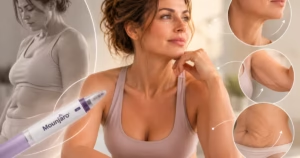

Weight loss can transform the body in just a few months. With medications such as Ozempic and Wegovy, many people can lose a significant amount of weight under medical supervision. However, a lower number on the scale does not always correspond to the aesthetic changes a patient expected.
After losing weight, some people notice that their abdomen remains loose, their arms have excess skin, or their thighs have lost firmness. Others notice facial changes, including reduced cheek volume and less defined facial contours.
These changes help explain why body recomposition has become an important topic for people experiencing significant weight loss.
Losing weight and reshaping the body are different processes. Weight loss involves reducing overall body weight, while body recomposition relates to the proportions of fat, muscle mass, and other tissues, as well as changes in body contours.
In this context, understanding what happens to the body after weight loss is essential for determining the next steps, whether through medical follow-up, physical exercise, nutritional care, or an assessment of potential aesthetic and surgical procedures.
What Happens to the Body While Using Ozempic and Wegovy?
Ozempic and Wegovy contain semaglutide, a substance that acts on GLP-1 receptors. It plays a role in regulating appetite and food intake, contributing to weight loss when used as medically indicated.
Although both medications contain the same active ingredient, their indications, formulations, and doses may differ. Therefore, they should not be treated as interchangeable products without professional guidance.
During weight loss, the body reduces its energy reserves. This reduction primarily involves body fat, but some loss of lean mass, which includes muscle and other tissues, may also occur.
The proportion of these losses varies according to factors such as diet, physical activity, individual characteristics, the amount of weight lost, and the duration of the process.
For this reason, results should not be assessed based on the scale alone.
Two people may lose the same amount of weight yet experience significant differences in muscle strength, body composition, and skin contours.

Losing Weight Does Not Necessarily Improve Every Body Contour
Weight reduction can bring important health benefits, but it does not guarantee that every area of the body will achieve the desired firmness.
This is because fat, muscle, and skin serve different functions.
Fat contributes to body volume. Muscles support strength, structural support, and the contours of certain areas. Skin must adapt to changes in volume, but its ability to retract varies from person to person.
When weight loss is substantial, this adaptation may not occur completely.
As a result, patients may notice:
- Reduced muscle volume in certain areas.
- Loose skin on the abdomen, arms, or thighs.
- Changes in breast shape.
- More noticeable skin folds.
- Changes in facial and neck contours.
These changes do not occur in everyone and do not necessarily indicate that weight loss happened incorrectly.
The important thing is to identify which changes are related to body composition, which involve the skin, and which may require a specific medical assessment.
What Is Body Recomposition?
Body recomposition is the process of changing the proportion of fat to lean mass, particularly muscle.
In practice, this means that a person may aim not only to reduce body weight but also to preserve or develop muscle mass and improve physical function.
This process can be important during and after weight loss.
A balanced diet, adequate protein intake when indicated, and strength training can contribute to muscle preservation and development. However, the strategy must be adapted to each person’s medical condition and individual needs.
It is important to clarify that body recomposition is not synonymous with eliminating all skin laxity.
Strengthening the muscles may improve the contours of certain areas, but it does not remove a significant amount of excess skin.
For this reason, nutritional support and physical activity may form part of the plan, without replacing medical assessment when substantial excess skin is present.
Why Can Skin Laxity Become More Noticeable After Weight Loss?
The skin contains collagen and elastin fibers that contribute to tissue support and elasticity.
As we age, these structures undergo natural changes. Genetics, sun exposure, a history of weight fluctuations, and the length of time the skin remained stretched also influence its ability to retract.
When a person loses a significant amount of weight, body volume decreases. However, the skin may not adapt to this reduction to the same extent.
At this point, some areas may begin to show more noticeable laxity.
The extent of these changes depends on several factors. The amount of weight lost is relevant, but it does not determine the outcome on its own.
Age, skin quality, fat distribution, and individual anatomical characteristics must also be considered.
Therefore, there is no formula that can predict how much excess skin will remain after using semaglutide.
The Face Also Needs to Be Considered During Recomposition
When people talk about body recomposition, they often think only about the abdomen, arms, and legs. However, the face can also undergo significant changes during substantial weight loss.
Reduced facial volume may make the cheeks appear less full and alter the transition between the face and neck. In some people, the jawline becomes less defined and skin laxity becomes more noticeable.
These changes should not be attributed exclusively to the medication. They may occur as a result of fat loss and individual characteristics of the aging process.
Furthermore, a thinner-looking face does not always indicate skin laxity.
In some patients, volume loss is the predominant change. In others, there may be a combination of reduced volume, changes in tissue support, and excess skin.
This distinction is essential when choosing an appropriate approach.
When Can a Facelift Be Considered After Weight Loss?
A facelift is a surgical procedure designed to address certain changes associated with aging and facial skin laxity.
After significant weight loss, it may be considered when substantial facial laxity is present and the patient’s anatomical characteristics make the procedure appropriate.
However, surgery is not automatically indicated for people who use Ozempic or Wegovy.
The surgeon needs to assess skin quality, tissue position, jawline contours, the neck, volume loss, and the patient’s expectations.
In some situations, the main concern may be volume loss rather than excess skin. In others, skin laxity may be the predominant issue.
Because these conditions are different, no single approach can address every case.
Deep Plane Facelift: The Technique Must Match the Anatomy
One of the techniques used in facial rejuvenation is the Deep Plane Facelift, which works on deeper tissue planes of the face.
In selected patients, this approach may be considered to address certain forms of skin laxity and reposition facial structures.
However, the technique should not be chosen simply because a patient has lost weight or because it is currently popular.
The decision depends on anatomy, the degree of skin laxity, tissue quality, medical conditions, and individual goals.
Planning must also take into account that surgery does not automatically restore all the facial volume lost during weight loss.
For this reason, a specialist assessment is essential to determine what can be treated, what limitations exist, and which results are realistically achievable.
What If Excess Skin Remains on the Body?
Body recomposition can improve muscle development and contours, but some people continue to have skin folds after substantial weight loss.
In the abdomen, for example, excess tissue may remain despite exercise. In the arms and thighs, skin laxity can alter contours and cause discomfort during certain activities.
In these cases, procedures such as abdominoplasty, brachioplasty, and thigh lift may be considered when indicated.
The choice depends on the amount of excess skin, the affected area, the patient’s medical condition, and individual goals.
It is important to distinguish localized fat, skin laxity, and muscle-related changes. Although they can occur together, these conditions are not equivalent and may require different strategies.
Is It Necessary to Wait Until Weight Stabilizes?
Weight stability is an important factor when planning plastic surgery after weight loss.
If a patient continues to lose a significant amount of weight, body contours may change again. This can affect surgical planning and the maintenance of results.
For this reason, the surgeon may recommend that the patient reach a more stable phase before undergoing certain procedures.
However, there is no single timeframe that applies to everyone. The decision depends on weight-loss progress, medical conditions, nutritional status, and the procedure being considered.
Diet and nutrient intake must also be assessed, as weight loss accompanied by insufficient nutritional intake may compromise surgical recovery.
Anyone using semaglutide should inform the surgeon and anesthesiologist about the medication, its dose, and the current stage of treatment. Semaglutide can delay gastric emptying, requiring individualized anesthetic planning.
Do not stop or change the medication on your own. Management must be determined by the healthcare professionals responsible for your treatment.
What Really Helps With Body Recomposition After Weight Loss?
The strategy depends on each person’s needs, but several aspects deserve attention.
Nutritional support: Helps assess protein, energy, vitamin, and mineral intake according to individual needs.
Strength training: When medically appropriate and approved, it contributes to muscle development or preservation.
Medical follow-up: Allows healthcare professionals to monitor weight changes, possible adverse effects, and the need for treatment adjustments.
Skin assessment: Helps distinguish mild laxity from a significant amount of excess tissue.
Individualized planning: Helps determine whether the patient should continue medical follow-up, consider nonsurgical treatments, or explore surgery.
None of these measures guarantees that the skin will completely return to its previous contours. Nevertheless, they can help establish an approach that better reflects each patient’s needs.
Follow our Instagramhttps://www.instagram.com/drjosecury/ profile.
Plastic Surgery Does Not Replace Body Recomposition
Plastic surgery can remove excess skin and modify certain body contours. However, it does not replace muscle strengthening, adequate nutrition, or medical follow-up.
Likewise, exercise and aesthetic treatments cannot remove a large amount of excess skin.
These approaches have different goals.
For this reason, a more appropriate plan begins by identifying what actually concerns the patient and which structures are involved.
In some situations, the best decision may be to continue medical follow-up and focus on body composition. In others, surgery may be considered to address changes that do not respond sufficiently to nonsurgical measures.
Body Recomposition and Facial Rejuvenation in São Paulo
Weight loss with Ozempic or Wegovy can represent an important transformation. However, the final result should not be assessed solely by the amount of weight lost.
Body composition, skin quality, and facial changes also deserve attention.
For patients experiencing facial laxity after weight loss, Dr. José Salim Cury (CRM-SP 150220) provides assessments focused on understanding changes in facial contours and the possibilities for facial rejuvenation.
During a consultation for a facelift in São Paulo, it is important to evaluate anatomy, volume loss, tissue position, and the medical conditions required before determining whether a procedure is appropriate.
The goal is to understand which changes can be addressed and which approach makes sense for each person, without assuming that every patient needs surgery.
Schedule a consultation with Dr. José Salim Cury (CRM-SP 150220) in São Paulo for an individualized assessment of facial changes after weight loss and to learn about treatment options suited to your case.
Informational content. Ozempic and Wegovy should be used as prescribed by a physician. The indication for aesthetic or surgical procedures depends on an individual assessment.