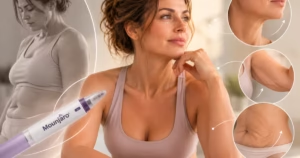
If this has happened to you, know that you are not alone.
As medications for weight management, such as Ozempic, Wegovy and Mounjaro, become more widely used, many people are discovering that weight loss can bring changes that go beyond the number on the scale. In some cases, reduced body volume is accompanied by skin laxity, folds of excess skin, and changes in facial and body contours.
This experience can bring mixed emotions. You may feel proud of your weight loss while also feeling frustrated with the appearance of certain areas.
All of these feelings deserve to be acknowledged without judgment.
Losing weight is a transformation. Learning to live with your body’s new contours can also be part of that journey.
Why Does Loose Skin Remain After Weight Loss Injections?
Medications such as Ozempic and Wegovy contain semaglutide, while Mounjaro contains tirzepatide. These substances act on mechanisms involved in appetite regulation and may contribute to weight loss when used as medically prescribed.
As you lose weight, your body volume decreases. However, your skin may not fully adapt to this reduction.
This happens because the skin’s ability to retract depends on several factors, including age, genetics, the amount of weight lost, and how long the skin has remained stretched.
Collagen and elastin help support the skin and maintain its elasticity. As we age and the skin remains stretched for prolonged periods, these structures can change, making it harder for the skin to return to its previous contours.
As a result, two people can lose the same amount of weight and experience different outcomes.
One person may notice only mild skin laxity. Another may develop more noticeable excess skin around the abdomen, arms, thighs or face.
This difference does not mean that one person has lost weight correctly and the other has not.
Every body responds differently.

Loose Skin Does Not Erase Your Achievement
There is a common expectation that weight loss will result in a completely firm body, with defined contours and no visible signs of transformation.
However, real bodies do not always match the idealized images seen on social media.
Excess skin can remain even when someone follows medical guidance and adopts healthy habits.
That is why it is important to distinguish between the outcome of the weight-loss process and the aesthetic changes that may remain afterward.
Skin laxity does not mean you lack discipline. It also does not mean your treatment has failed.
It may be a consequence of reduced body volume combined with the individual characteristics of your tissues.
Recognizing this can help reduce feelings of guilt and allow you to view your body with greater understanding.
When Your Face Also Changes After Weight Loss
Changes do not occur only in the abdomen, arms or legs.
The face can also lose volume after significant weight loss.
In some people, the cheeks appear less full, the jawline becomes less defined, and laxity in the lower face or neck becomes more noticeable.
These changes can be particularly sensitive because our faces play a direct role in how we recognize our own image.
Sometimes, a person sees the weight loss but feels that their appearance looks more tired or that their facial contours have changed more than expected.
It is important to understand that these changes are not the same for everyone.
In some cases, volume loss is the main concern. In others, the issue is tissue laxity or a combination of different factors.
Before considering any procedure, it is therefore necessary to understand what has actually changed.
Skin Laxity After Weight Loss Injections: What Can Help?
The answer depends on the degree of skin laxity and the area affected.
When the changes are mild, certain nonsurgical treatments may help improve the appearance and firmness of the skin in selected patients.
Nutritional guidance and physical exercise can also help preserve muscle mass and improve body contours.
However, there is an important distinction: improving skin quality is not the same as removing a significant amount of excess skin.
When there is substantial excess tissue, creams, exercise and aesthetic devices cannot reproduce the effect of surgery designed to remove that skin.
This does not mean that everyone who loses weight will need surgery.
It simply means that treatment should be appropriate for the changes being addressed.
When Can Plastic Surgery Be Considered?
Plastic surgery may be an option when excess skin remains after weight loss and causes aesthetic or functional discomfort.
For the body, an evaluation may include procedures such as abdominoplasty, brachioplasty, thigh lift and certain breast surgeries.
For the face, a facelift may be considered for selected patients who have significant facial laxity.
The recommendation depends on the amount of excess skin, the patient’s anatomy, overall medical condition and individual expectations.
It is also important to assess whether the patient’s weight is sufficiently stable and whether their body is in suitable condition for recovery.
There is no universal timeline that determines the right moment for surgery. This decision should be discussed with the healthcare professionals involved in the patient’s care.
Facelift After Weight Loss: When the Face Needs Special Attention
When weight loss changes facial contours, a facelift may be considered for patients with significant skin laxity.
The surgery aims to address certain changes in the tissues of the face and neck. However, it should not be understood simply as a way to tighten the skin.
Planning must consider the relationship between the skin, deeper tissues, facial volume and individual proportions.
One of the available techniques is the Deep Plane Facelift, which addresses deeper tissue planes in the face. Its suitability depends on each patient’s anatomy and needs.
In some situations, the main issue is volume loss rather than excess skin. In these cases, a facelift alone may not address every concern or meet all expectations.
That is why a specialist evaluation is essential to identify the changes present and discuss treatment options clearly.
You Don’t Have to Make Every Decision Right Now
After significant weight loss, you may feel an urge to quickly address every change you notice in your body.
However, you do not need to turn every concern into an immediate decision.
The first step may be to understand what has happened to your skin, monitor changes in your weight and assess your overall health.
A qualified professional can then help you understand which options may be appropriate for your situation.
Some people may benefit from nonsurgical treatments. Others may consider surgery. In some cases, waiting and continuing clinical follow-up may be the most appropriate course of action at that time.
The important thing is to avoid making decisions based solely on comparisons with other people or promises of quick results.
How Can You Choose a Treatment Without Unrealistic Expectations?
The internet offers countless solutions for skin laxity. Some promise to restore firmness in just a few sessions. Others suggest that a single procedure can completely restore your previous contours.
However, results vary, and no treatment produces the same response in every patient.
Before choosing an approach, it is worth considering a few questions:
- What is the actual degree of skin laxity?
- Is there excess skin, or is volume loss the main concern?
- Has the patient’s weight become relatively stable?
- Which treatments are appropriate for this particular case?
- What are the benefits, risks and limitations of each option?
- What results are realistically achievable?
These questions help support an informed decision that aligns with each person’s individual needs.
Caring for Your Appearance Can Also Be Part of Your Health
Caring about your appearance does not have to be a source of guilt.
For some people, treating skin laxity means feeling more comfortable in certain clothes. For others, it means improving body contours or feeling more like themselves when they look at their facial features.
These desires can be legitimate, provided decisions are made with information, safety and realistic expectations.
Plastic surgery should not be an obligation after weight loss. Nor does it need to be ruled out when a change causes concern and there is an appropriate medical indication.
The most suitable approach is one that considers your health, your body’s characteristics and your personal goals.
Follow our Instagram profile.
Losing Weight Was One Stage. Understanding Your New Body Is Another.
If you lost weight with injectable medication and noticed that your skin did not fully adapt to the transformation, you do not need to see this as a setback.
Your body has undergone significant changes. The next step is to understand which changes are a natural part of the process, which may improve over time, and which deserve specialist assessment.
In Dr. José Salim Cury’s practice (CRM-SP 150220), individualized assessment is essential to understanding facial changes and discussing rejuvenation options based on each patient’s anatomy and needs.
For people who notice facial laxity after significant weight loss, a consultation can help clarify whether a facelift may be appropriate or whether other approaches may be more suitable.
Facelift in São Paulo: An Assessment Designed Around You
Weight loss does not have to come with pressure to achieve a specific aesthetic standard.
If changes in your face have become a concern, the first step is to seek specialist guidance and understand the options available.
An assessment with Dr. José Salim Cury (CRM-SP 150220) in São Paulo allows facial contours, tissue quality and individual characteristics to be evaluated before any procedure is discussed.
Schedule a consultation to understand the changes that can occur after weight loss and explore treatment options that may be appropriate for your situation.
You do not need to compare your journey with anyone else’s. Care should begin with understanding your own body.