
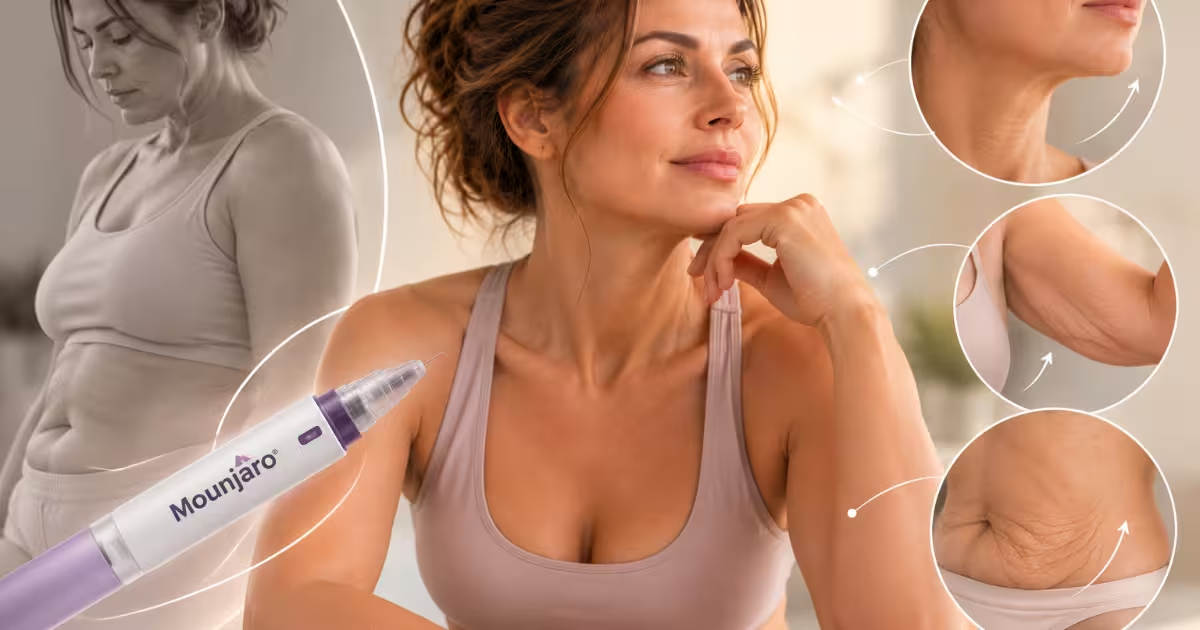
Weight loss can bring significant changes to health, self-esteem, and appearance. With the growing popularity of medications such as Mounjaro, whose active ingredient is tirzepatide, many people are facing a new question after losing weight: how can they address skin laxity and excess skin that may remain?
A reduction in body volume is not always accompanied by complete skin retraction. In some patients, changes become more noticeable in the abdomen, arms, and thighs. In others, the face loses volume, affecting facial contours, jawline definition, and the neck.
In this context, plastic surgery may become part of the discussion. However, losing weight with Mounjaro does not necessarily mean that a patient will need surgery.
Whether surgery is appropriate depends on the changes observed, tissue quality, health conditions, and individual goals. Planning must also consider the appropriate timing for surgery and specific precautions related to the medication.
Why Can Skin Become Loose After Mounjaro?
Mounjaro is a medication containing tirzepatide, which acts on GIP and GLP-1 hormone receptors. When used as medically indicated, it can help with weight and blood glucose management.
When significant weight loss occurs, body fat volume decreases. However, the skin does not always adapt to this reduction to the same extent.
This happens because tissue retraction capacity varies from person to person. Collagen and elastin contribute to skin support and elasticity, but their characteristics are influenced by factors such as age, genetics, and a history of tissue stretching.
Factors that may influence skin laxity after weight loss include:
- Total amount of weight lost.
- Age and genetic characteristics.
- How long the skin remained stretched.
- Speed and history of weight loss.
- Tissue quality and elasticity.
- Affected body area.
- Previous weight fluctuations.
Therefore, it is not accurate to claim that Mounjaro directly causes skin laxity in every patient. Excess skin can develop after different forms of weight loss, particularly when the reduction in body volume is substantial.

Can People Who Lose Weight With Mounjaro Undergo Plastic Surgery?
Yes. Using tirzepatide does not automatically prevent someone from undergoing plastic surgery.
However, the decision requires careful medical evaluation. The surgeon needs to understand how the weight loss occurred, whether the patient’s weight is still changing, and which changes remain after the reduction in body volume.
It is also important to determine whether the patient is in suitable clinical condition for the procedure.
During this evaluation, the following factors may be considered:
- Weight history and weight-loss progress.
- Medications being used and their respective doses.
- Diabetes or other medical conditions.
- Nutritional status and protein intake.
- Skin quality and amount of excess tissue.
- Preoperative tests and anesthetic assessment.
- Expectations regarding the results.
This assessment helps determine whether surgery is indicated and whether the timing is appropriate.
In some situations, it may be necessary to wait until further stages of medical treatment have been completed. In others, the patient may be ready to proceed with planning, provided that the relevant safety criteria are met.
Is Weight Stabilization Necessary Before Surgery?
Weight stability is an important consideration when planning plastic surgery after significant weight loss.
When weight loss is ongoing, body and facial contours may change again. This can affect surgical planning and the maintenance of results.
For this reason, the surgeon may recommend that the patient reach a more stable phase before undergoing certain procedures.
However, there is no single timeframe that applies to every case. Appropriate timing depends on weight-loss progress, clinical conditions, nutritional status, and the type of surgery being considered.
It is also important to assess whether the patient can maintain adequate nutrition during treatment. Insufficient nutrient intake may compromise recovery and should be identified before elective surgery.
The decision should be made jointly by the healthcare professionals responsible for the patient’s treatment, taking individual needs into account.
Do People Taking Mounjaro Need to Stop the Medication Before Surgery?
This is one of the most important considerations in preoperative planning.
Tirzepatide can delay gastric emptying, causing stomach contents to remain in the stomach for longer. During procedures involving general anesthesia or deep sedation, this may increase the risk of pulmonary aspiration, which occurs when stomach contents enter the respiratory tract.
Brazil’s National Health Surveillance Agency (Anvisa) has warned about this risk and recommends that healthcare professionals identify the use of these medications before procedures involving anesthesia or deep sedation.
This does not mean that every patient needs to discontinue the medication for the same period.
Management should be individualized, taking into account factors such as:
- Current dose and stage of treatment.
- Recent dose increases.
- Nausea, vomiting, abdominal distension, or other gastrointestinal symptoms.
- The reason for taking the medication, including diabetes management.
- The type of surgery and planned anesthetic technique.
- Individual aspiration risk and other potential complications.
Recent clinical guidelines reinforce the importance of an individualized perioperative strategy. Depending on the case, the healthcare team may determine adjustments to preoperative dietary intake, fasting, medication management, and anesthetic safety measures.
Patients should not stop taking Mounjaro on their own. The decision must be coordinated among the prescribing physician, plastic surgeon, and anesthesiologist.
Which Plastic Surgery Procedures May Be Considered After Weight Loss?
The choice depends on where excess skin is present and which changes remain after weight loss.
There is no single surgical procedure capable of addressing every change caused by weight loss. Each procedure has its own indications and limitations.
Abdominoplasty
When significant excess skin is present in the abdomen, abdominoplasty may be considered to remove excess tissue and improve abdominal contours.
Some patients may also have changes in the abdominal wall that require assessment. Residual fat, in turn, requires a different evaluation from that used to assess skin laxity.
Brachioplasty and Thigh Lift
Brachioplasty may be indicated in selected cases involving excess skin on the arms. A thigh lift may be considered when significant laxity affects this area.
Both procedures require an assessment of the amount of excess tissue, the resulting scars, and the patient’s expectations.
Breast Surgery
After significant weight loss, the breasts may experience volume loss, skin laxity, and changes in position.
Depending on the patient’s anatomy and individual goals, options such as mastopexy, with or without implants, or other surgical approaches may be considered.
The decision should not be based solely on the desire to restore previous breast volume. Tissue quality and the expected outcome must also be considered.
Facelift and Facial Rejuvenation
The face can also undergo significant changes after weight loss.
Volume loss may make the cheeks appear less full, accentuate folds, and alter the contours of the jawline and neck. In some people, skin laxity becomes more noticeable.
In these cases, a facelift may be considered when there is an appropriate clinical and anatomical indication. However, it is essential to distinguish volume loss from skin laxity and excess skin, as these changes are not equivalent.
How Can Weight Loss Change the Face?
Facial transformation deserves special attention because the face depends on a balance between different structures.
Fat reduction can change the volume of the cheeks and other areas. At the same time, changes in tissue support may contribute to a loss of definition in facial contours.
Therefore, not every change observed after weight loss should be treated as excess skin.
During a facial assessment, the surgeon may evaluate:
- Volume in the cheeks and surrounding areas.
- Jawline definition.
- Skin laxity in the lower face.
- Neck contours and the area beneath the chin.
- Skin quality and tissue position.
- Facial proportions and individual characteristics.
This assessment helps determine which changes can realistically be addressed and what results may be achievable.
Deep Plane Facelift: When Can This Technique Be Considered?
The Deep Plane Facelift is one of the techniques used in facial rejuvenation. It addresses deeper tissue planes, aiming to reposition facial structures according to the patient’s needs.
After significant weight loss, this technique may be considered when there is substantial facial laxity and the patient’s anatomical characteristics are compatible with its use.
However, losing weight with Mounjaro does not mean that a person needs a Deep Plane Facelift or that this is necessarily the most appropriate technique.
Planning should take into account the degree of skin laxity, skin quality, volume loss, anatomy, and the patient’s expectations.
In certain situations, other approaches may be more suitable. In others, surgery may not be necessary.
The most important consideration is that the recommendation should be based on an individual medical assessment, rather than the popularity of a particular technique.
Can Plastic Surgery Restore the Face to Its Pre-Weight-Loss Appearance?
It is not possible to guarantee that the face or body will return exactly to its previous appearance.
Surgery can correct certain changes, such as excess skin, and improve the contours of treated areas. However, it does not eliminate every change associated with aging or volume loss.
In the face, for example, removing skin does not automatically restore the volume lost from the cheeks.
For this reason, surgical planning must clarify what each procedure can address and which limitations need to be considered.
A sound decision begins with realistic expectations and an understanding that every person’s body responds differently.
What Should Patients Consider Before Surgery?
Preparing for plastic surgery after weight loss involves more than evaluating the skin.
The body needs to be in suitable condition to undergo the procedure and recover afterward.
Important considerations include:
Nutritional status: Reduced appetite may make it difficult for some people to consume enough nutrients. The physician may assess dietary intake and request tests when necessary.
Medical conditions: Diabetes, high blood pressure, and other health conditions must be appropriately evaluated and controlled.
Current medications: It is essential to disclose all medications, supplements, and other substances being used, including tirzepatide.
Anesthetic planning: The anesthesiologist must be informed about the patient’s medical history and any medication that may affect gastric emptying.
Expectations and recovery: Patients need to understand the risks, limitations, possible scars, and care required after surgery.
These measures do not guarantee that complications will not occur, but they help the healthcare team identify risks and plan appropriate safety measures.
Follow our Instagram profile.
Plastic Surgery After Mounjaro Requires Individualized Assessment
Weight loss with medications such as Mounjaro can represent an important step in many people’s health journeys. However, changes in the body and face do not follow a single pattern.
Some patients experience good skin retraction. Others develop excess tissue in specific areas. Some also notice facial changes related to volume loss and skin laxity.
For this reason, the decision to undergo plastic surgery should not be based solely on the number of kilograms lost or the use of a specific medication.
It is necessary to evaluate anatomy, tissue quality, weight-loss progress, nutritional status, medical conditions, and individual goals.
When facial rejuvenation is being considered, this assessment is particularly important for distinguishing skin laxity, volume loss, and changes in facial contours. Understanding these differences helps guide the choice between nonsurgical treatments, surgical procedures, or no intervention at that time.
Facelift in São Paulo: Careful Planning After Weight Loss
For people who notice facial changes after losing weight with Mounjaro, a consultation with a plastic surgeon offers an opportunity to understand which changes are present and which options may be considered.
Dr. José Salim Cury (CRM-SP 150220) works in plastic surgery, with a focus on facial rejuvenation and procedure planning tailored to each patient’s characteristics.
When assessing a patient for a facelift in São Paulo, the evaluation should consider not only the skin but also facial volume, tissue position, proportions, and the clinical conditions required for surgery to be performed safely.
The decision to undergo surgery should be based on information, careful planning, and realistic expectations. Using the medication alone does not determine whether surgery is necessary or which technique is appropriate.
Schedule a consultation with Dr. José Salim Cury (CRM-SP 150220) in São Paulo to assess facial changes after weight loss and learn about treatment options suited to your individual case.