Losing weight can be a major achievement.
After months or even years of working toward weight loss, seeing the body change can bring a sense of accomplishment. Clothes become looser, measurements decrease, and the silhouette takes on new contours.
But there is a situation that surprises many people: the weight goes down, but the skin does not change in the same way.
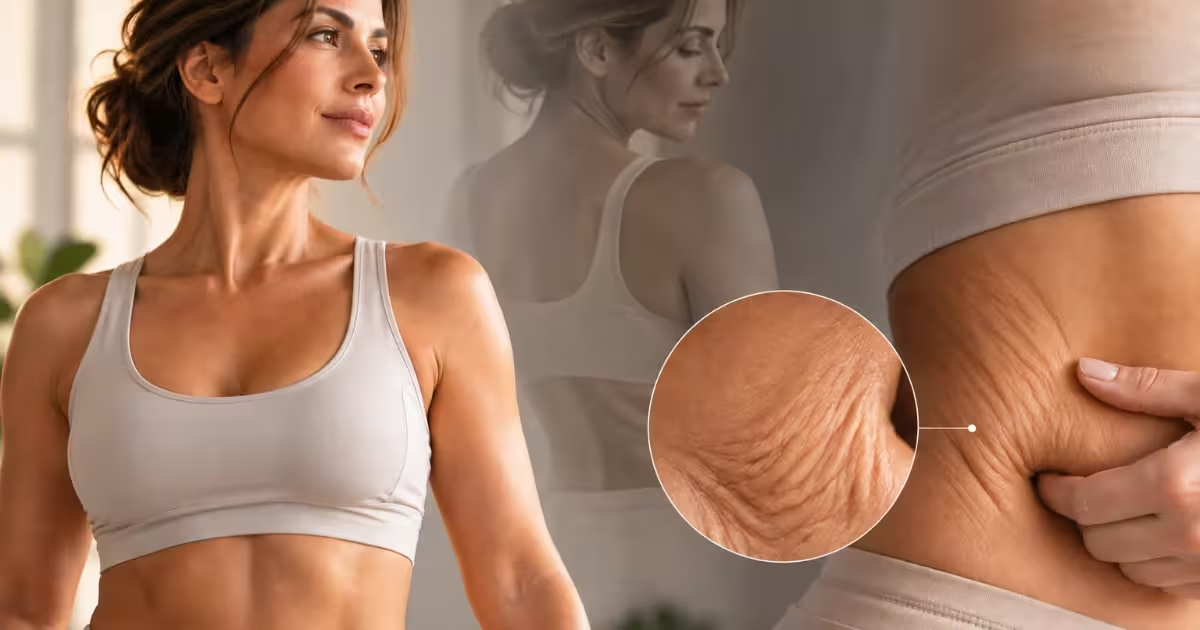
The abdomen may be left with excess skin. The arms may develop laxity. The thighs may lose firmness. In some cases, the area of the body that causes the most concern is no longer the fat, but the tissue that remains after weight loss.
This can create a contradictory feeling.
A person reaches an important goal but still does not feel comfortable with their body.
Why does this happen?
The answer involves the biology of the skin, especially structures such as collagen and elastin, as well as the speed and extent of weight loss, age, genetics, and individual tissue characteristics.
In some cases, when there is significant excess skin, plastic surgery may be part of body contouring treatment.
Why does skin become loose after weight loss?
The skin has the ability to adapt to changes in the body.
When body volume increases, the skin stretches. When weight is lost, the tissues need to adapt again to a body with less volume.
The problem is that this adaptation does not happen in the same way for everyone.
The skin contains structural fibers responsible for properties such as strength and elasticity. Among them, collagen and elastin play important roles.
Collagen contributes to the structure and strength of tissues.
Elastin is associated with the skin’s ability to stretch and partially return to its previous shape.
When the skin remains stretched for a prolonged period, its ability to retract may decrease.
That is why some people are left with excess skin after significant weight loss.

What are collagen and elastin?
To understand laxity after weight loss, it is helpful to know two important components of the skin’s structure.
Collagen is an abundant structural protein in the body. In the skin, it contributes to tissue support and strength.
Elastin forms fibers that contribute to skin elasticity, allowing it to stretch and partially return to its previous configuration.
These structures do not work in isolation.
The skin also depends on other components of the extracellular matrix, as well as factors related to hydration, thickness, and tissue organization.
As we age, the production and organization of structural components of the skin undergo changes.
For this reason, two people who lose the same amount of weight may experience different degrees of skin laxity.
Why can rapid weight loss leave more excess skin?
The speed of weight loss can influence how the tissues adapt.
When a person loses a significant amount of weight over a relatively short period, body volume may decrease faster than the skin can adapt.
However, it would not be correct to say that all rapid weight loss necessarily causes excess skin.
The response depends on several factors.
These include:
- total amount of weight lost;
- speed of weight loss;
- age;
- genetics;
- skin quality and elasticity;
- how long the skin remained stretched;
- amount of muscle mass;
- body region;
- previous weight fluctuations.
Therefore, there is no formula that can predict exactly how each person’s skin will respond to weight loss.
Why do some people have more excess skin than others?
Skin elasticity varies considerably from one person to another.
One person may lose 30 kilograms and have relatively little excess skin. Another may lose a similar amount and develop significant laxity.
This happens because each person’s body has its own characteristics.
Age also plays a role.
As the years pass, changes occur in the structure and ability of tissues to renew themselves. The skin tends to become less elastic, with changes in the production and organization of collagen and elastin.
Genetics also contributes to this response.
In addition, the length of time that the skin remained stretched may make a difference.
Therefore, the result of weight loss cannot be assessed based solely on the number of kilograms lost.
Can skin retract after weight loss?
To some extent, yes.
The skin has some ability to retract and adapt. After weight loss, a gradual reduction in excess tissue may occur over time.
However, this ability is limited.
When there is a significant amount of excess skin, the body may not be able to eliminate it naturally.
This is when many people begin researching plastic surgery after weight loss.
The question shifts from simply “How can I lose more weight?” to “What can be done about the excess skin that remains?”
Can exercise eliminate excess skin?
Exercise is important for health, body composition, and maintaining muscle mass.
It can also improve body contour by contributing to muscle development.
But there is a difference between improving muscle definition and removing excess skin.
When there is a significant amount of excess skin tissue, exercise cannot simply eliminate it.
This does not mean that physical activity is not important.
On the contrary.
It can be part of preparing for and maintaining the results of body contouring treatment, according to medical guidance.
However, it is important to have realistic expectations about what exercise can and cannot change.
Can creams restore the skin after major weight loss?
Creams and skincare products can contribute to hydration and the superficial appearance of the tissue.
However, they cannot remove large amounts of excess skin.
The same applies to cosmetic treatments that promise to significantly “shrink” the skin after substantial weight loss.
When there is structured excess skin, the evaluation needs to consider the degree of laxity and the characteristics of the tissue.
In some cases, surgery may be the option capable of physically removing the excess.
However, this decision depends on a medical evaluation.
When does laxity become more than a cosmetic concern?
Excess skin can cause physical discomfort, not just dissatisfaction with appearance.
Depending on its amount and location, excess tissue can make activities, clothing, and care of certain areas of the body more difficult.
Some people may also experience friction between skin folds.
Therefore, evaluating a patient after significant weight loss should consider both aesthetic aspects and functional effects.
The areas most commonly affected include:
- abdomen;
- arms;
- thighs;
- flanks;
- chest;
- back;
- lower body.
Each area has its own characteristics and may require a different approach.
When can plastic surgery become part of the treatment?
Surgery may be considered when there is significant excess skin and the patient is clinically suitable for the procedure.
The decision should not be based solely on the number of kilograms lost.
The surgeon needs to assess the body as a whole.
During the consultation, the following may be evaluated:
- amount of excess skin;
- location of the laxity;
- tissue quality;
- weight stability;
- presence of localized fat;
- condition of the musculature;
- existing scars;
- health history;
- expectations regarding the outcome.
This evaluation helps determine which procedures may be considered.
What surgeries can be performed after major weight loss?
There is no single surgery for every patient.
The procedure depends on the areas affected and the amount of excess skin.
In some cases, an abdominoplasty may be considered, especially when there is excess skin and laxity in the abdominal area.
When the excess skin is mainly on the arms, an arm lift, or brachioplasty, may be considered.
When the main concern is the thighs, a thigh contouring procedure may be considered in selected patients.
In people who have experienced very significant weight loss, several areas may have excess skin at the same time.
In these cases, the treatment plan may involve procedures performed in stages.
The strategy should prioritize safety, body proportions, and individual characteristics.
Abdominoplasty after weight loss: when may it be indicated?
The abdominal area often undergoes significant changes after major weight loss.
There may be excess skin, laxity, and residual fat.
Abdominoplasty may be considered when there is significant excess skin in the abdominal area and an indication for its removal.
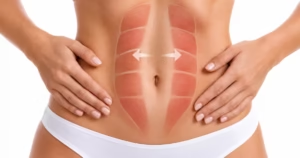
The procedure may also involve treatment of the abdominal wall, depending on the findings of the evaluation.
However, it is important to distinguish between different changes.
Liposuction primarily addresses localized fat.
Abdominoplasty has, among its goals, the treatment of excess abdominal skin.
In some patients, different approaches may be combined.
The indication depends on the patient’s anatomy and the medical treatment plan.
Is it necessary to stabilize weight before body contouring surgery?
In many cases, weight stability is an important part of the planning process.
When a patient is still losing weight, further changes in the body may alter the amount of excess skin and the body contour.
Performing surgery before reaching a more stable phase may make it more difficult to plan the outcome.
Therefore, the appropriate timing needs to be discussed individually.
The surgeon should also evaluate the patient’s clinical and nutritional condition.
After major weight loss, this assessment becomes even more important.
Is surgery after weight loss meant to “finish” the weight-loss process?
No.
This is an important point.
Body contouring surgery does not replace the weight-loss process.
It can address changes that remain after weight loss, especially excess skin.
Imagine a person who has lost a significant amount of weight and reached a stable range. However, the abdomen still has a large amount of excess skin.
In this situation, the goal of surgery is not to make the person lose weight again.
The purpose is to treat the tissue that remained after the body’s transformation.
This distinction helps establish more realistic expectations.
Can surgery restore exactly the body from before weight gain?
This cannot be guaranteed.
The body undergoes structural changes over time.
The skin may have been stretched for years. Body composition may have changed. Muscle tissue may also have undergone changes.
Therefore, the goal of surgery is to improve body contour within each patient’s anatomical possibilities.
The result does not represent a literal return to the past.
It is a new body configuration built from the body as it is today.
This perspective is important for patients to understand both the potential benefits and the limitations of the procedure.
Weight loss changes the body. The relationship with your body may change too.
There is an emotional dimension that is often overlooked.
After significant weight loss, some people expect to finally feel comfortable with their bodies.
When they find excess skin where the fat that once bothered them used to be, they may experience an unexpected sense of frustration.
It is important to recognize that this does not diminish the achievement of losing weight.
The transformation remains significant.
When indicated, plastic surgery may be part of a later stage focused on body contouring.
However, this decision should be made without rushing and with realistic expectations.
Plastic surgery after weight loss in São Paulo
For those seeking plastic surgery after weight loss in São Paulo, a specialized consultation is the starting point.
Dr. José Salim Cury (CRM-SP 150220) performs an individualized evaluation to understand how weight loss has changed the body and which areas present excess skin, laxity, or other changes.
The goal is to assess the body as an integrated whole.
In high-standard plastic surgery, planning should not begin with choosing a technique.
It should begin with understanding the patient.
This involves assessing proportions, tissues, body history, and goals.
Based on this analysis, surgical options can be discussed, including procedures for different areas of the body when indicated.
What defines high-standard body contouring surgery?
The concept of high-standard care goes beyond physical facilities or the experience offered to the patient.
In plastic surgery, it is also related to the level of treatment individualization.
Careful planning considers details that can influence the outcome.
These include:
- detailed anatomical analysis;
- careful surgical indication;
- personalized technique selection;
- attention to body proportions;
- scar planning;
- transparent discussion of limitations;
- appropriate follow-up;
- focus on proportional, natural-looking results.
After a major body transformation, there is no room for a generic solution.
Each patient comes to surgery with a different story.
Follow our Instagram profile.
Your weight loss was an achievement. Surgery can be a new stage.
If you have experienced significant weight loss and now notice excess skin, know that this situation may have a biological explanation.
The skin has limits to how much it can retract.
Collagen and elastin help explain part of this capacity, but age, genetics, the amount of weight lost, the length of time the skin remained stretched, and individual characteristics also influence the outcome.
That is why the skin cannot always simply “go back to where it was.”
And when significant excess skin remains, it does not mean that you did anything wrong.
It means that your body has undergone a major transformation.
In some cases, plastic surgery may be considered as a stage of body contour restoration, always following an individualized evaluation.
You lost weight, but were left with excess skin and still don’t feel comfortable with your body?
The next step does not necessarily need to be losing even more weight.
It may be understanding what has actually changed in your anatomy and what options are available to address those changes.
Schedule a consultation with Dr. José Salim Cury (CRM-SP 150220) in São Paulo for a personalized evaluation of your body contour.
During the consultation, you can understand whether surgery may be indicated, which areas can be treated, and what strategy may be appropriate for your case.
Your weight loss was an achievement. Planning the next stage also deserves precision, safety, and individual attention.
Schedule your consultation and talk to a plastic surgeon about the possibilities for your body.